Optimizing the Optimizers — optopt
1 · What a MIP solver does while it runs
A mixed-integer program (MIP) minimises a linear objective subject to linear constraints, where some variables must be integers. Scheduling, routing, unit commitment and bin packing are all MIPs. Solvers such as HiGHS, SCIP and NVIDIA cuOpt search a tree of subproblems (branch-and-bound), and at every moment they know two numbers:
- the incumbent — the best feasible solution found so far (an upper bound when minimising);
- the bound — a proof that no solution can be better than this value (a lower bound), from LP relaxations and cuts.
The gap between them shrinks during the run; when it reaches zero the incumbent is proven optimal. Practitioners often stop long before that and care mostly about how fast a good incumbent appears.
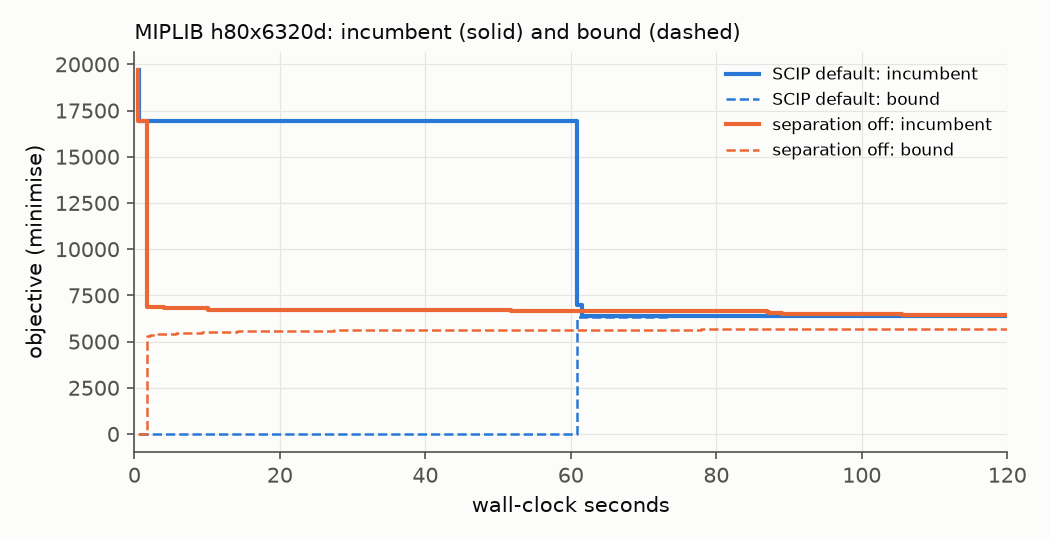
The figure shows one MIPLIB instance (h80x6320d) solved twice by SCIP for 120 s. With its default settings SCIP spends
the first minute without improving its first solution; with cut separation switched off it finds a good solution
within seconds — yet the default ends slightly better at 120 s. Same solver, same problem, a different
configuration, and which one is “better” depends on whether you value being early or ending best (chapter 2).
| setting | first good incumbent | incumbent at 120 s |
|---|---|---|
| SCIP default | after ~61 s | 6 382 |
| SCIP, separation off | after ~2 s | 6 465 |
Hands-on. python tutorials/examples/ex01_first_mip.py builds a random set-cover problem and prints every incumbent
and the bound as SCIP and HiGHS find them.
Try: raise rows/cols in examples/common.py to make the problem harder and watch the gap close more slowly.