Optimizing the Optimizers — optopt
6 · Parallel copies and learned selectors
Parallel copies. If the best setting depends on the run, run several and keep the best — the algorithm portfolio idea (Gomes & Selman 2001). On a DGX Spark a CPU solver and the GPU solver can run side by side: HiGHS on one thread next to cuOpt captures about 80 % of the per-instance headroom with no model at all (estimated from recorded runs); run live on 80 MIPLIB instances, the pair improves on HiGHS alone by 30 %. Copies of SCIP that differ only in the random seed also help, with diminishing returns:
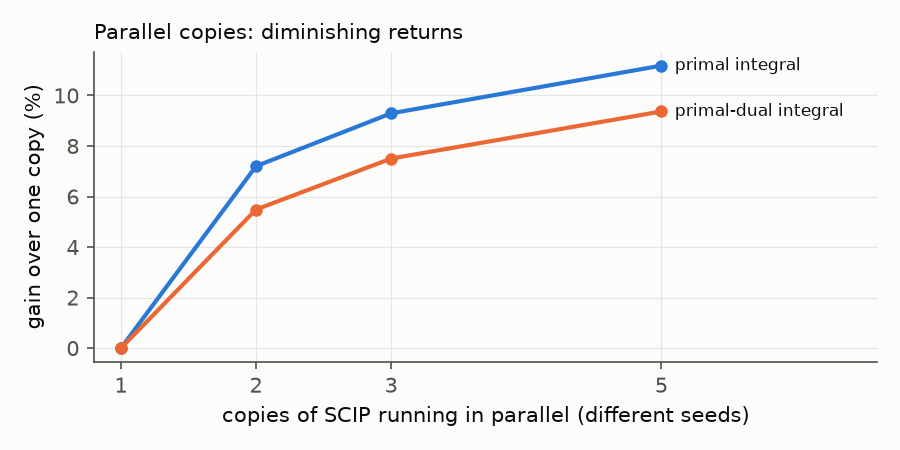
| SCIP copies (different seeds) | 2 | 3 | 5 |
|---|---|---|---|
| gain in primal integral | 7 % | 9 % | 11 % |
| gain in primal-dual integral | 5.5 % | 7.5 % | 9.4 % |
Parallel copies use more compute; compare them with other uses of the same cores, not with a single run.
Learned selectors. Can a model read a problem and pick the right setting before the solve? The paper compares gradient-boosted trees (LightGBM), a small neural network, and a 421M-parameter decision model (Laya), all reading 62 simple statistics of the problem. At a 10 s budget they close a quarter to a third of the gap to the oracle, and compared directly neither LightGBM nor Laya is shown to be better than the other; at 30 s none reliably beats always using the single best strategy. On a problem family left out of training, the fine-tuned Laya held up better than LightGBM. Rule of thumb from the project: if a simple model is as good, use the simple model.
Where to go next: resources.md, and the paper’s appendix for every experiment that did not work.